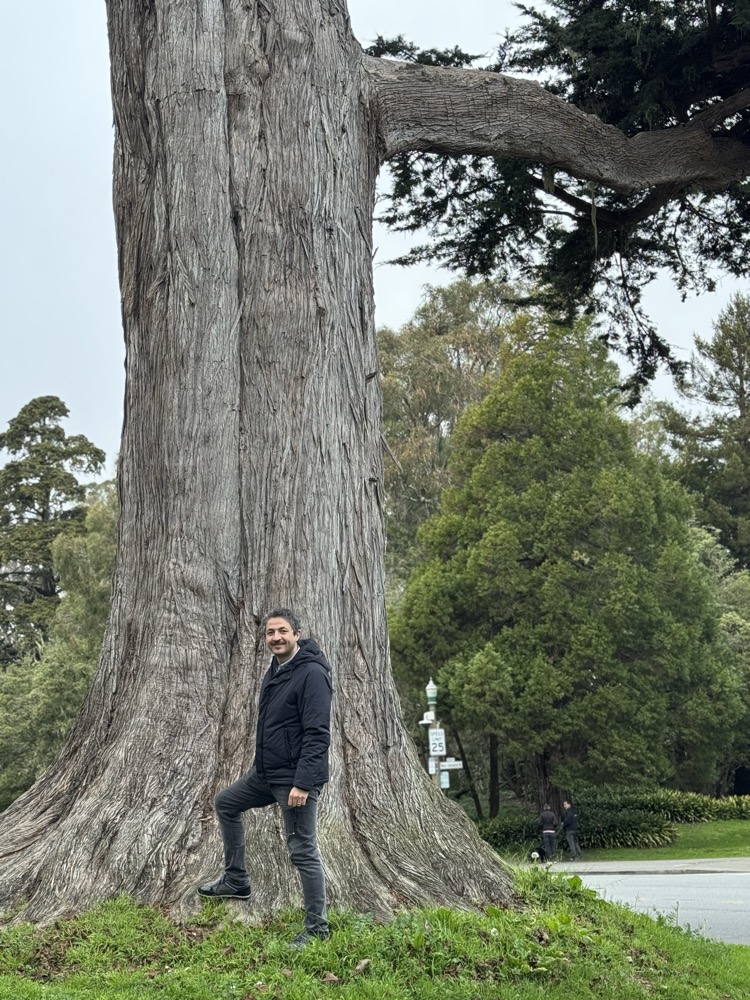
Hamid is a software engineer with a decade-plus of building backend systems that quietly hold things together. These days, with an AI pair to help him move faster, he's just as comfortable stepping into frontend work — the underlying concepts carry over more than people expect. All of it driven by an equally long-running curiosity about what makes people, code, and companies actually work.
He holds a Ph.D. in Software Engineering from McMaster University and currently leads engineering efforts at Amazon Advertising. Outside of work: reading more than is reasonable, long podcasts, travel when the excuse presents itself, and time with family that doesn't get interrupted by a laptop.
He's not out looking for the oldest tree in every city — but when he crosses paths with one, he stops.
There's something about a tree that's been standing in the same spot for decades, sometimes centuries. It hasn't gone anywhere. It's just stayed, day and night, through every season, watching the same patch of sky. A very old, very patient kind of witness.
A good chunk of how he builds software has quietly changed in the last couple of years. Design discussions, first-draft infrastructure, the edge cases you'd normally only catch at 2am — a lot of that now runs through an AI pair before it ever reaches a human reviewer. It hasn't replaced judgment; it's mostly just removed the boring tax on having it.
A Ph.D.'s worth of papers on model-driven engineering, if that's ever useful to you —a few of them are here.